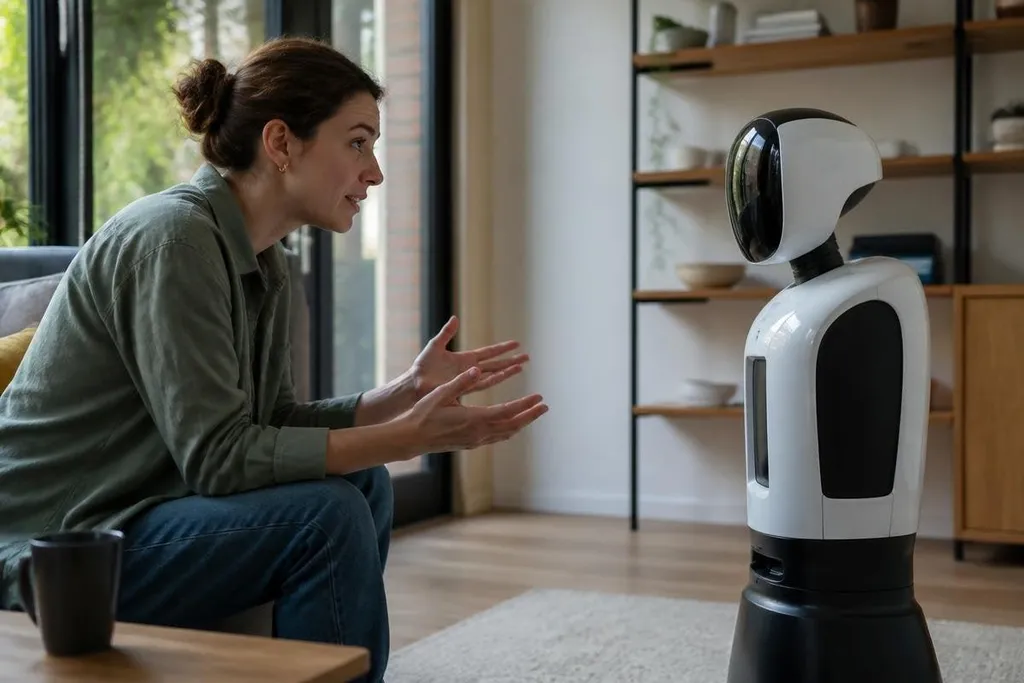
A robot can read a smile, a raised voice, or a change in posture. It can't know from those signs alone whether a person feels happy, nervous, tired, or polite. That gap matters when robots work near people, respond to customers, or help with care tasks.
- Robots read signals, not private feelings
- Context can change the meaning of the same face or voice
- A safe system should show uncertainty and allow correction
How robots read emotion
Most emotion systems collect visible or audible signals. Cameras measure facial movement, microphones process speech, and other sensors can track body position or movement. Software then compares those signals with patterns it has learned.
A face with raised cheeks may look like a smile. A louder voice may suggest anger. A person who turns away may want to end a conversation. These clues can help a robot choose a response, but each clue has more than one possible meaning.
The robot does not read a feeling as a direct fact. It makes a guess from measurements. In technical terms, the system estimates an emotional state from sensor data, much as a navigation system estimates where a vehicle is from camera or LiDAR readings.
That difference changes how the robot should act. A system that guesses “angry” should not treat the guess as proof. It might lower its speaking volume, ask the person to repeat themselves, or wait for a clearer signal.
Why context causes trouble
The same expression can mean different things. A smile may show pleasure, nervousness, social habit, or an attempt to stay polite. A quiet voice may signal sadness, tiredness, respect, or a noisy room that makes speaking difficult.
Culture, age, disability, language, lighting, and camera position also affect the signals a robot receives. A face partly covered by a mask gives the software less visual information. A person with limited facial movement may show emotion in ways the system was not trained to read.
This creates a problem for companies selling emotion features. A high score on a controlled test does not show that a robot will read people well in a busy shop, hospital, or home. The setting changes the data, and the data changes the guess.
The robot also needs memory of the conversation. If someone says, “Great, another delay,” their words may sound positive when taken alone. The surrounding sentence and the event being discussed carry the meaning.
What a useful system should do
A practical robot should use emotion signals to adjust its behavior, not to make hidden judgments about a person. That could mean giving someone more time, asking for confirmation, or handing a task to a human worker.
The interface should show when the system is unsure. A message such as “I may have misunderstood” gives the person a chance to correct the robot. Silent guesses are harder to spot, especially when the robot controls access, service, or care.
Privacy adds another limit. Emotion systems may process faces, voices, and movement in places where people did not expect that analysis. A company needs a clear reason to collect those signals, a clear retention period, and a way for people to refuse where the setting allows it.
A claim that a robot reads emotion needs the named signal, test setting, and result beside it. Robot24.com reporting on emotion-sensing robots can tie those details to the machine and the people affected before the next section checks what still lacks proof.
What remains unproven
The phrase “recognize human emotions” sounds more exact than the technology is. A robot can classify visible patterns or estimate a likely state. That does not prove it has found the person’s real feeling.
The open problem is reliability outside the test setting. A system may work with clear lighting, a quiet room, and people who face the camera.
Its results may change when a person is moving, speaking another language, wearing protective equipment, or showing an emotion in an unfamiliar way.
I’d treat emotion recognition as a support signal, never as a final decision about a person.
Before buying or approving a system, use this check:
- Ask what sensors the robot uses and what each one can miss.
- Request test results from settings close to your own workplace or home.
- Check how the robot reports uncertainty and accepts correction.
- Set rules for storing faces, voices, and other personal data.
- Keep a human review step for safety, care, access, or discipline.
What to ask before deployment
Start with the task, not the label. If the goal is to notice distress, define the action that follows and the point where a person takes over. If the goal is better service, compare emotion signals with simpler measures such as a spoken request or a manual help button.
The system may become better at reading signals as sensors and software improve. The useful measure will be whether people receive better help without losing control over how the system judges them. Until that is shown in the setting where the robot will work, emotion recognition remains an aid for interaction, not a reading of the human mind.